
Unnamed
At the Edge of Sense

On March 7th, I drove from Annapolis, Maryland to Great Barrington, Massachusetts, to see Nora Bateson speak with Báyò Akómoláfé in a “W.EB. Du Bois Fellowship Conversation” put on by the Schumacher Center for New Economics, titled “Unnamed: A Conversation at the Edge of Sense”, moderated by Alex Forrester. I had been made aware of Bayo when, at Warm Data Host training in September of last year, I found myself in a room of lovely, thoughtful people who nearly all seemed aware of, and in awe of, this Nigerian philosopher who had hosted an event with Nora months before in Big Sur, California. I watched Bayo’s talk Ghostlights of the Political, Part 1, shared through another sensemaking/complexity community; and the odd, energetic, casual clarity with which he playfully, poetically riffed on new and interesting ontological experiments made me excited to see him speak with Nora.
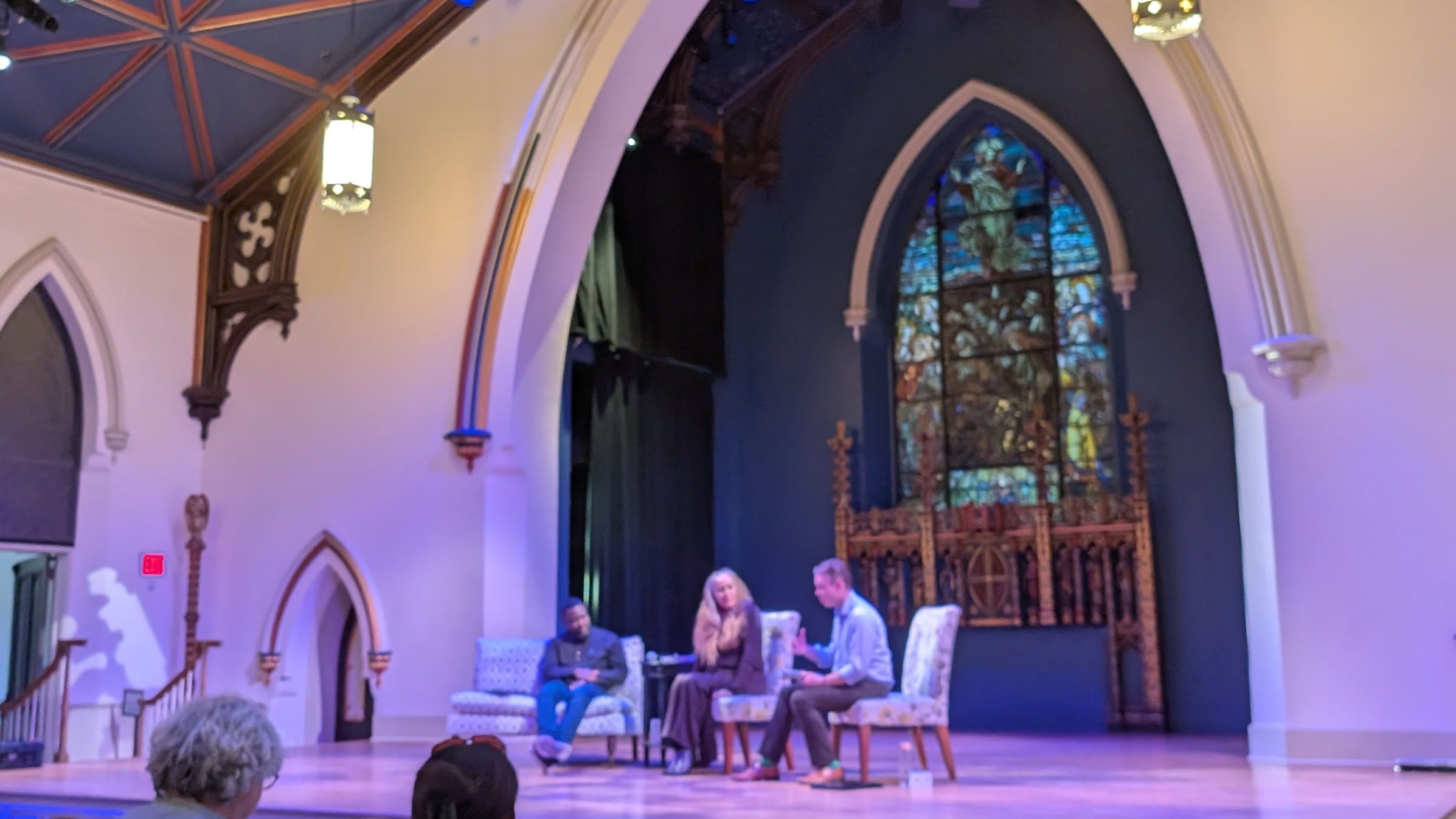
“Unnamed” is of course an interesting name for a thing. For me, it brings to mind the mantra of Arya Stark in Game of Thrones—”A girl has no name”—as she trained to be a faceless/multi-faced assassin for a period before reclaiming her identity and her past, a prerequisite step to enacting violent retribution on behalf of her family. Perhaps a person with no name has no family. Isn’t a name a core component of any history, especially a shared history? And thus to be an historic agent, an aspect of a coherent historic unfolding, one must first be named. To be named is to be legible, and legibility in most cultures includes being categorically tied to relational context (surnames being the most clear example—an invention specifically propagated in certain cultural contexts to account for, and make legible, patrilineal property rights); but naming traditions are at times also considered cosmically deterministic and are often intended to be contextually descriptive.
'''Is it true that you get your names from a computer?'
'Yes.'
'How dreary, to be named by a machine!'
'Why dreary?'
'It's so mechanical, so impersonal.'
‘But what is more personal than a name no other living person bears?'
'No one else? You're the only Shevek?'
'While I live. There were others, before me.'
'Relatives, you mean?'
'We don't count relatives much; we are all relatives, you see.’
-The Dispossessed, Ursula K. Le Guin
In their opening remarks, all three speakers in “Unnamed” reflected almost immediately on the serious task of naming their children at birth. Hearing this, I reflected on the passivity with which I barely participated in the naming of my own two children, being of the opinion that they—my daughter Rebecca and son Daniel—and the substrate of their experience would be the source of whatever meaning might adhere to those names which had been given them. Their mother was much more certain in her approach to the task, arriving at these names through two very different means, and I was happy to defer to her conviction, being relatively unserious about the implications of any name.
The seriousness with which people take naming their children brings to mind how transgender and nonbinary people often discard their given names, choosing a new name for themselves which intentionally severs them from the historicity of that label which, probably like many things in their lives, failed to reflect a latent, unspoken, perhaps undiscovered truth and identity. A name which was an integral aspect of a system of legibility which impeded such discovery, names being often decidedly gendered—the gendered name a social technology to signal how to think about and engage with a person, how to feel about their choice of clothing and colors and profession. And then of course the real spills over the edges of genders and names, neither of which are particularly suited to contain the multitudes which we contain. The seriousness of parental naming might lead some to perceive this self-renaming as profaning the sacred. But to the self-determined or self-discovered, the true profanity is deadnaming—conjuring up that abandoned label like an ontologically shackling curse.
A phrase that came up several times among the speakers was this quote from Nora’s writing:
“Words are a spell”
Given names are often discarded at the most sacred of moments. In the Orthodox Christian tradition, new names (saints’ names) are often adopted by converts at baptism. Renaming is common also in conversion to Judaism and Islam. I vividly recall as a child witnessing the Orthodox baptismal ritual, particularly when the priest, after a series of personal excommunications, asks the convert whether they “renounce Satan and all his works, and all his worship, and all his angels, and all his pomp”, and upon affirming three times that they do renounce Satan, the person is told, “then blow and spit upon him” before being turned to face East for the more affirming part of the script. I watched in gross fascination as adult converts spit onto the floor of the church. Profaning is clearly part of the point here. Perhaps the same could be said for declaring a given name “dead”. To symbolically denounce one’s own given name is significant—fitting for any serious reclamation of agency, for any escape from the binding constraints of someone else’s imposed ontology. In shedding a name they escape from.
But then in adopting a name, they escape to.
Escape is a common theme in Bayo’s work. He often refers to fugitivity or onto-fugitivity, a slippery concept which the moderator Alex described as “being beyond legibility”, which Fabrice Olivier Dubosc described like this:
Akómoláfé queers and “composts” previous theological traces, rewiring their deep intuitions with contemporary cutting-edge critical thinking. Historical examples of fugitivity include slaves’ practices of marronage, fleeing to the mountains or starting autonomous quilombos. Another way they resisted assimilation was through the adoption of mimetic attitudes, hiding diasporic spiritual practices in the colonizer’s own rituals, furthering creolization and new relational contexts while keeping alive and renewing an “Afrocenic” ethos. Such fugitive sanctuary “at a standstill” – this “generative incapacitation” – dances open a portal out of carceral dimensions rather than reinforcing their status quo by “speaking truth to power.”
In Bayo’s own words on the subject:
One might say fugitivity is the theology of incalculability and hopelessness. The fugitive rejects the promise of repair and refuses the hope of the established order. By clinging to outlawed desires, barely perceptible imaginations, alien gestures, the fugitive inhabits the moving wilds. S/he lives in open spaces, with rogue planets and stars astride a curious sky, in the tense betweenness of things. God, surprisingly in love with the fugitive, often meets the fugitive in that space between stories to break him open, to show him a burning bush, to rename him, to gobble him up with mouth as wide as a whale’s, and then perhaps to spit him out again. Fugitivity is the site of hopelessness, of so-called defeat, of modest bearings and whispered songs. For citizens of the Anthropocene, who must meet the incomprehensibility of the moment, the fugitive’s path glows in the dark. There, where the path in the call to defeat leads, we might come face to face with something deeper than solutions. Something too sacred for words to embrace.
Bayo made clear that the fugitivity being discussed that night wasn’t about a departure from modernity to some utopian place beyond naming. It is instead about how the real spills out, over and beyond ontological designations, which are incapable of containing it. How the real and its latent potential operates and gestates possibility in the cracks, in “that space between stories”:
“There is the tendency to think of what we’re naming as the unnamed as some pristine forest outside of the city. That’s how we think in modernity, in binaries. We think, ‘oh there’s some place that’s called the unnamed’ and our gentrifying minds want to move there. It’s like ‘oh let’s get a plot there, you know? Build a house’. It’s not like there’s some place called the unnamed over there. The idea of the unnamed is that names are not particularly totalizingly dedicated to identification. We give names to identify things. I’m trying to say that names have secret lives… We’re trying to say that names are not entirely given to nameability. That they have minor gestures. They have strange commitments.”
A beautiful example he gave of these “minor gestures and strange commitments” was how during the transatlantic slave trade, Yoruba slaves who were brought to the Americas and forced to worship the god of their Christian masters, hid their own gods (orishas) behind the names of Jesus, Mary, the saints, and apostles. The names serving only as containers for their own truths, made seemingly legible to their oppressors, who were unaware that their religion was being inseminated with a virus (Bayo’s words) which potentiated, from the cracks between cosmologies, the emergence of the syncretic religions of Candomblé and Santería—beautiful examples of fugitivity, which Bayo also described as “The inability of place to completely hold a body”.
"The slaves were brought into the churches to be Christianised. The Spaniards hoped they would depart from their old beliefs. But things did not go quite as the slave-owners and clergy had envisioned. Instead of rejecting their own gods, the slaves continued worshipping them inside the church itself, disguised inside the Catholic cult of saints. The slaves found out that each of their African santos could be concealed behind a corresponding Catholic saint. Changó [the santo of lightning and thunder] could thus be concealed behind Saint Barbara, and Ochún [the santo of love] behind Caridad de Cobre. The slaves could thereby continue their own beliefs and cults within the walls and countenance of the church, but still concealed from the clergy."
- University of Oslo historical museum article on the history of Santeria
For much of my 5-hour drive to Great Barrington, I was listening to R.F. Kuang’s dark academia fantasy novel “Katabasis”, about a pair of graduate students studying magic at Cambridge University—Alice and Peter, who descend to hell to rescue the soul of their thesis advisor. I reached one part of the story where, between the courts of Desire and Greed, they encounter an unhinged Chinese deity called the Weaver Girl (织女 (Zhīnǚ)) who, after a bit of interaction, Alice believes to be “quite hamming it up” with regards to her own tragic backstory, and opines internally “but perhaps this is just what deities do with all of their free time—perfect their own mythologies.”
I paused the book to think a while, because this is a comment that I find deeply interesting. Perfecting our own mythologies might be a great way of describing the solipsistic habits of self-perception, self-explanation, and presentation we’ve developed—performativity even—shaped by social media in an archetype-obsessed culture. How frequently and strongly do we relate to our own fabricated mythologies, or those fabricated categorically for us, and how do these serve as containers to make our experience legible, and at what expense? I believe that in increasingly embedding ourselves within these fabricated mythologies we effectively decomplexify ourselves, discounting all of the real which spills over the borders of the simplifying narrative.
A core aspect of the ideology of optimization in which we are all socially embedded is self-mythologizing (nowhere is this more evident than on LinkedIn) and naming is an integral aspect of this process. We position ourselves within the simplifying framework of a hero’s journey with a heading—an archetype whose name (man, woman, leader, warrior, lover, god, intellectual, American, academic) contains within it a host of cultural assumptions, reinforced through shared stories, about our role, what better means and what worse means, what stages we must traverse, what suffering, to earn the predesignated gifts of the goddess, and what specifically those gifts are for.
How we long for narrative simplicity. How we desire to be nestled neatly within an unfolding history, whose past and therefore future can be comprehended through a reductionist process of zooming into the atomistic layer of first-order causation. Great men manually steering the ship of history, their bulging muscles honed through myriad dark nights of the soul at the local crossfit gym, straining against the currents of chaos, or the forces which decohere narrative coherence.
The invocation of names is often how we summon a caricatured history to reduce and make simple sense of the present, to designate its characters and beats and acts and thus its seemingly inevitable, repetitive and stereotyped trajectories.
Is one of those trajectories that arc of history, which Reverend Martin Luther King Jr. said was long but “bent towards justice”? Bayo invoked King in one of his comments that night at Unnamed, but not, as one might expect, to reinforce an expected trajectory or scheme of perception, but to undermine a dominant, colonizing mythology. He shared this tragic quote from King in a conversation with Harry Belafonte, shortly before his assassination: “We have fought hard and long for integration, as I believe we should have, and I know that we will win. But I’ve come to believe we’re integrating into a burning house.”
King experiencing a dark night of the soul immediately before his death illustrates one of my grievances with the monomyth (which I was pleased to see Dave Snowden take up as a point of critique in recent writing). There is an obvious narrative-structural reason that I had never heard this story, and I assume you have not either. It is because it is an aspect of the real which spills out and beyond the containers of instrumental mythology.
In a 2020 article on this exact subject, Mike Jones said “The Dr. King we celebrate is an homage to the myth of America.” He said that every American reduces King to the words of those two improvised sentences in the closing of his August 1963 speech at the March for Jobs and Justice, and these words in particular “…because they align with the myth that Americans have substituted for history.”
In response to King’s grief, Belafonte asked what should be done about this “burning house” problem, and King suggested we must “become firemen”.
Bayo challenged this framing, since firemen fight fire from the outside, which couldn’t possibly apply here because “we ourselves are the fire”, and fire cannot stand outside a building and wield hoses.
He suggested that a better course of action was to somehow “become water”.
He then said of course that’s impossible. But all the more reason we should do it.
The moderator Alex asked Bayo to reflect on his work on “para-politics” and the “sideways approach”, first referencing Nora’s writing on systems, and “how the world is not comprised of cause-and-effect circuits… how we have this habit of looking for first-order causation… and that you can’t actually change a system but you can ready a system for change.”
Bayo began his response with,
I think that the deepest spell that modernity has as a civilizing ethic is the proposal that we think before we act… I’m saying that modernity presupposes that that is actually the case. That we have thoughts in our heads and then they bleed into decisions and the decisions become actions…. that when you go to the voting booth… you have your belief systems already intact, and your thoughts. You’ve done your research and you go to the booth with your research in your mind intact, and then you secrete said research in the ceremony of voting for someone. And this sequentiality (according to modernity) is how things work… But it starts too late. I’m going to repeat Karen Barad—when you start with the individual, you’re too late. When you start with the decider who decides, or the author who writes… you’re too late. You’ve already cut out the entire world.
Bayo is articulating that what happens when a person “acts” is the outcome of what Nora calls nth-order causation.
I feel that I am somewhat predisposed to the implications of these explorations. I have spoken often over the years about how I have clearly understood my many accomplishments and failures as outcomes of how I am potentiated by my context. I usually use this as a way of describing the ethical burden of leadership roles within institutions like the Air Force, because institutions grant some people outsized (and ethically dubious) influence over potentiating factors for human thriving and impact. My passive self-description as “potentiated” to outcomes versus focusing more on my own agency to create those outcomes despite context might strike you as either impotent confession or bland observation depending on how you currently see the world.
Because of the culture we together occupy, it is likely that you see people as independent, powerful, individual agents whose agency is possessed by them and potentiated by how they have exercised that agency in the past. Did they accept those calls to adventure which would have set them on the clockwork course of a hero’s journey towards heroic optimization? Did they waste their potential by allowing themselves to be victims of circumstance, and fail to potentiate their own capacity? Their own intelligence? This explains their failures. This explains their incorrect views.
Meanwhile, your correct views are the product of doing the research.
Your salvation is because you took decisive right action aimed at the right deity.
To outsource your own agency to context, you might think, is having a victim mindset.
This common pitfall of thinking, a nice mashup of “self-serving bias” and fundamental attribution error excuses the withholding of empathy.
The alternative, which does not start at the individual, is to understand that I am not just I. My thoughts are not just mine. Many of them belong to bacteria which comprise more cells of my mass than my organs or tissue or bones do. And that’s just the beginning, because the world is acting through me and I can hardly tell. I am a description of countless people and environments (via abductive process)… and it is simply not enough to call these mere influences; because I am not separate, standing outside of these things and metabolizing them systematically, choosing to either integrate or not integrate them. The diffuse edges of me which extend backwards in time are in constant communication with these aspects, without “me”—my conscious illusion of a fully bounded self—having any say in most of those interactions. When you speak to me you are speaking also to the redwood forests which I wandered as a child, to my family and friends and communities and to the conflicting cultures which are tissued into my flesh and my mind and the mites which live on my eyelashes, and my beloved gut bacteria whose neurobiotic sense I have ignorantly been claiming as my own thoughts and appetites.
This is not to say that there is no such thing as an individual. There is and yet paradoxically there also isn’t. Individual is perhaps just a name for something which will never actually contain what it claims to contain.
This is not to say that the individual has no agency. It is to say that agency is distributed. That I am the crest of a crashing wave, which is also the water which surged upward from swells of the infinite ocean comprised of nothing less than everything, and this wave will crash, and recede, and crash again, breaking into fluid pieces and recombining and breaking again and reuniting with its infinite nature, so long as these waters can still move. So long as we don’t insist on holding them fast and placid in concrete pools.
I didn’t drive all the way to Great Barrington to be a recipient of intelligent explanations, so that I might upgrade those intact beliefs which I possess and carry around inside my head. Reviewing the tape gave me plenty of access to the words and sentences arranged here. I went because I am affected deeply, energetically, motivationally, and perceptually by being in direct contact with these thinkers and their expressions, because there is significantly more information at play, more communication than can be found on the transcript. This meandering piece of writing isn’t the outcome of me the individual absorbing, digesting, and producing mere words. It is potentiated largely by energies which are collaboratively metabolized, gifted to me from in-person exchange, and which I feel compelled to propagate in a somewhat transformed state, having passed through me and the multitudes contained within me.
It has never been so clear to me how diffuse I actually am, how porous are the boundaries between what I consider “me” and what I consider “others” or the world.
I’m reminded, by the words of Euvie Ivanova that “becoming porous” is one way of framing intimacy, by Adrienne Maree Brown that my quality of life and survival are tied to how authentic and generous are the connections between me and people and place.
Perhaps porousness is how we might occupy more than merely the containerized space of the named—one way of spilling out into, and operating within, being part of the creative alchemy within those cracks between stories. Escaping from, without escaping too intractibly into another incarceral dimension whose walls are built of words.
Becoming, impossibly, water.
Perhaps we too should become more illegible, to fit less into simplifying narratives. To see more of ourselves in others, and less of ourselves in our selves.
To see more of the world in ourselves.
To be more than just the crest of that crashing wave and realize that we are necessarily also the ocean. A roiling, intermingling mass of difference, never quite static. Always creating and combining.
And mostly un-nameable
“All language is spells. And in fact, so is silence.”
-Nora Bateson